How to Upload Pictures Directly to the Kirita Canvas
Working with Images
Computers piece of work with files and every bit a painting programme, Krita works with images as the type of file it creates and manipulates.
What practise Images Contain?
If you take a text document, information technology of class contains messages, strung in the right society, so the computer loads them as coherent sentences.
Raster Data
This is the main data on the paint layers yous make. So these are the strokes with the pigment brush and look pixelated up close. A multi-layer file will contain several of such layers, that go overlaid on top of each other and then make the final image.
A unmarried layer file will unremarkably merely incorporate raster data.
Vector Data
These are mathematical operations that tell the computer to draw pixels on a spot. This makes them much more scalable, considering you lot just tell the performance to make the coordinates 4 times bigger to scale it up. Due to this vector data is much more editable, lighter, but at the same time information technology's also much more CPU intensive.
Operation Data
Stuff similar the filter layers, that tells Krita to change the colors of a layer, but as well transparency masks, grouping layer and transformation masks are saved to multi-layer files. Being able to load these depend on the software that initially made the file. And so Krita tin load and salve groups, transparency masks and layer effects from PSD, but non load or save transform masks.
Metadata
Metadata is information similar the cosmos engagement, author, description and also data like DPI.
Image size
The image size is the dimension and resolution of the sail. Prototype size has direct effect file size of the Krita document. The more pixels that need to be remembered and the college the bit depth of the color, the heavier the resulting file will be.
DPI/PPI
DPI stands for Dots per Inch, PPI stands for Pixels per Inch. In printing industry, suppose if your printer prints at 300 DPI . It ways it is actually putting 300 dots of colors in an surface area equal to an Inch. This means the number of pixels your artwork has in a relative surface area of an inch.
DPI is the business concern of the printer, and artists while creating artwork should proceed PPI in mind. According to the PPI you have set, the printers can decide how large your image should be on a slice of paper.
Some standards:
- 72 PPI
-
This is the default PPI of monitors every bit assumed by all programs. It is not fully correct, as nearly monitors these days take 125 PPI or even 300 PPI for the retina devices. Withal, when making an image for estimator consumption, this is the default.
- 120 PPI
-
This is often used as a standard for low-quality posters.
- 300 PPI
-
This is the minimum you should use for quality prints.
- 600 PPI
-
The quality used for line art for comics.
Color depth
We went over color depth in the Color Management page. What you need to empathise is that Krita has paradigm color spaces, and layer color spaces, the latter which can relieve retentiveness if used correct. For example, having a line art layer in grayscale can half the retentivity costs.
Prototype color space vs layer color space vs conversion.
Considering in that location's a departure between image color space and layer color space, you can alter just the prototype color infinite in which will leave the layers alone. But if you want to change the color space of the file including all the layers you can do it by going to this will convert all the layers color infinite as well.
Author and Clarification
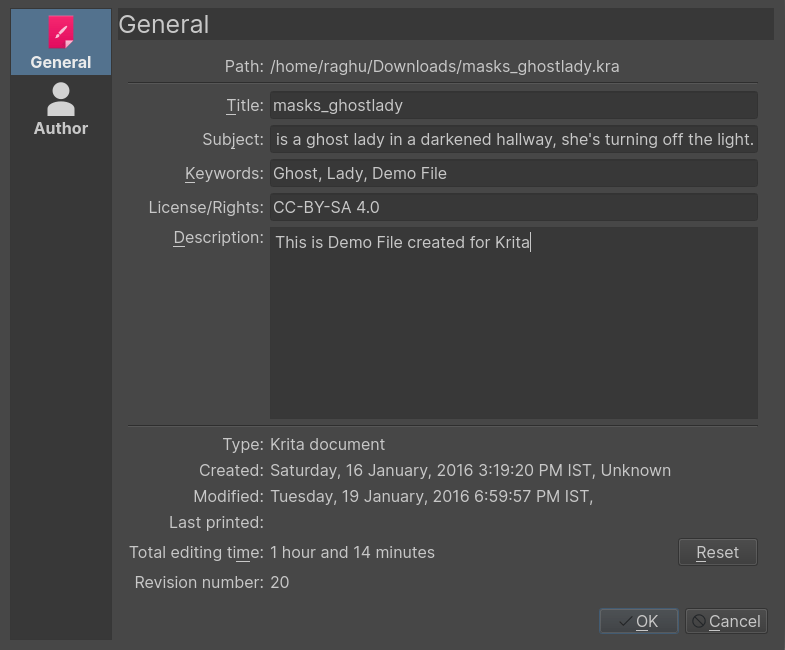
Krita will automatically salve who created the image into your image's metadata. Along with the other data such as time and appointment of creation and modification, Krita besides shows editing time of a document in the document information dialog, useful for professional illustrators, speed-painters to go along rails of the time they worked on artwork for billing purposes. It detects when you lot haven't performed actions for a while, and has a precision of ±60 seconds. You can empty it in the document info dialog and of form past unzipping you .kra file and editing the metadata there.
These things tin can exist edited in , and for the author'south information . Profiles can be switched nether .
Setting the sail background color
You tin can set the canvass background color via menu item. This allows you to turn the groundwork colour not-transparent and to modify the color. This is too useful for certain file formats which force a background colour instead of transparency. PNG and JPG export employ this color as the default color to fill in transparency if you exercise not want to consign transparency.
If you lot come in from a plan like Pigment Tool SAI, then using this pick, or using Every bit canvas colour radio push at Groundwork: department in the new file options, volition allow you lot to work in a slightly more comfortable environment, where transparency isn't depicted with checkered boxes.
Basic transforms
There are some basic transforms available in the Image menu.
- Shear Paradigm…
-
This will allow you to skew the whole prototype and its layers.
- Rotate
-
This evidence a submenu that will permit you to rotate the image and all its layers rapidly.
- Mirror Prototype Horizontally/Vertically
-
This will allow you to mirror the whole epitome with all its layers.
But there are more options than that…
Cropping and resizing the sail
You tin can crop and prototype with the Crop Tool, to cut away extra space and ameliorate the limerick.
Trimming
Using , Krita resizes the image to the dimensions of the layer selected. Useful for when y'all paste a besides large prototype into the layer and desire to resize the canvas to the extent of this layer.
is a faster cousin to the ingather tool. This helps usa to resize the canvass to the dimension of any active selection. This is especially useful with correct-clicking the layer on the layer stack and choosing Select Opaque. will so ingather the canvas to the choice bounding box.
is actually for layers, and will trim all layers to the size of the paradigm, making your files lighter by getting rid of invisible information.
Resizing the canvas
You can also resize the sail via (or the Ctrl + Alt + C shortcut). The dialog box is shown beneath.
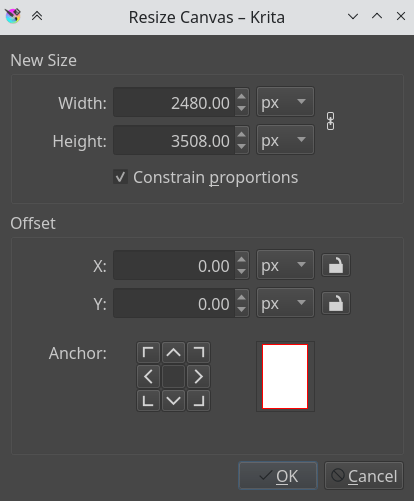
In this, Constrain proportions checkbox volition make sure the height and width stay in proportion to each other equally you modify them. Offset indicates where the new canvas space is added around the electric current image. You basically decide where the current image goes (if you printing the left-button, it'll go to the center left, and the new canvas space will be added to the right of the epitome).
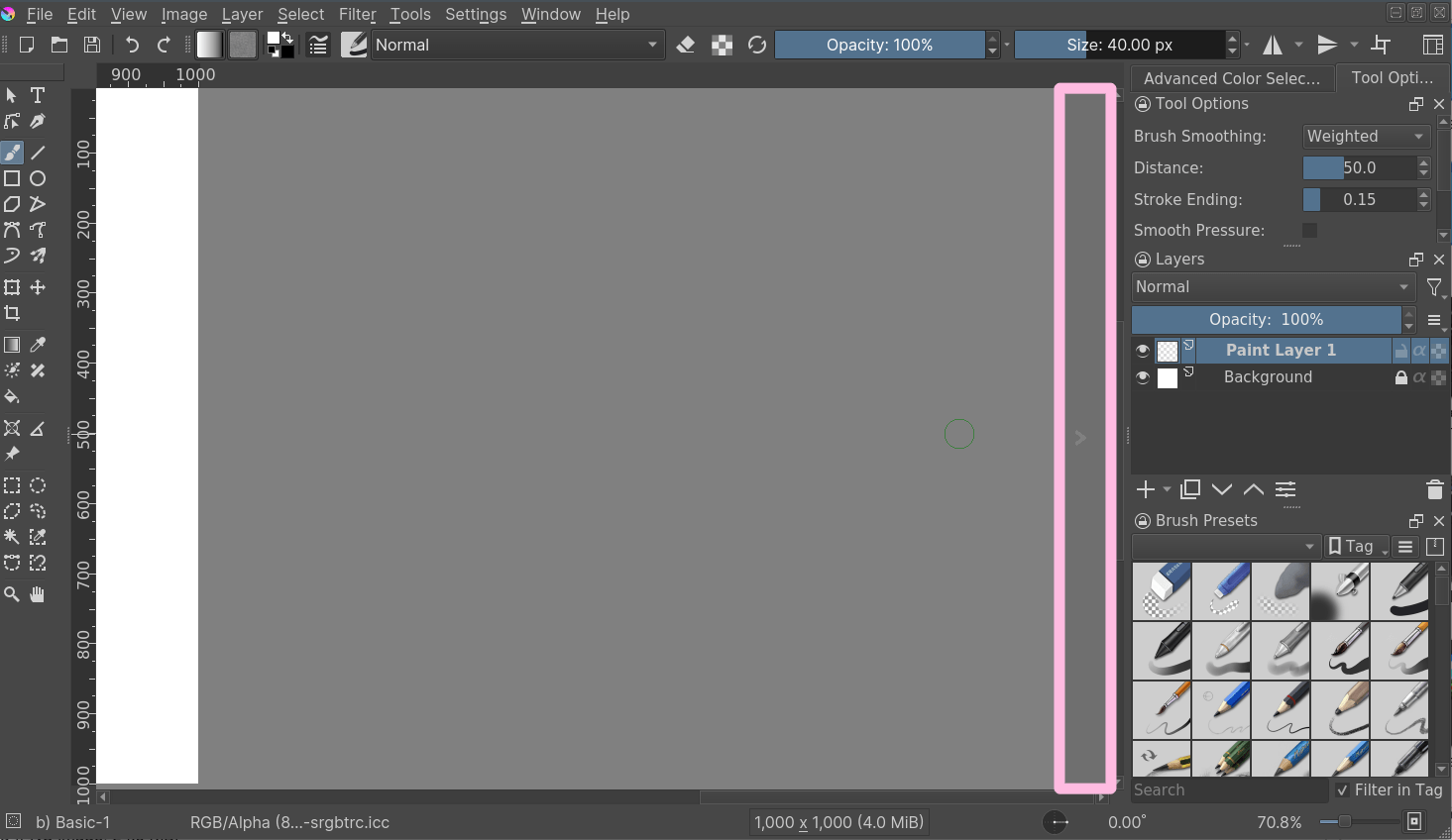
Another fashion to resize the canvas according to the need while drawing is when you scroll abroad from the stop of the sail, yous can see a strip with an arrow appear. Clicking this will extend the sheet in that direction. You can see the pointer marked in red in the example beneath:
Resizing the prototype
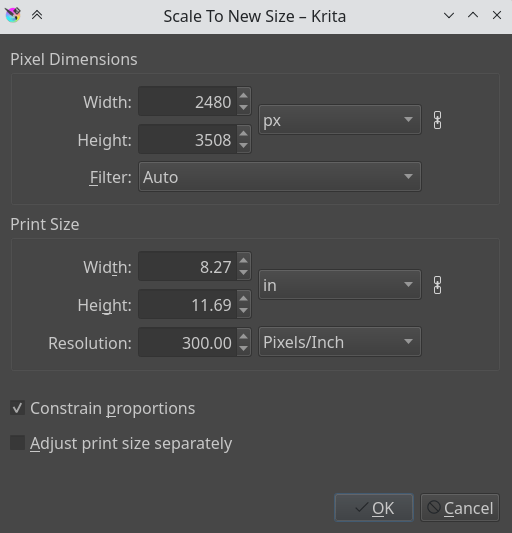
Scale Prototype to New Size… allows you to resize the whole image. Besides, importantly, this is where you tin modify the resolution or upres your paradigm. So for instance, if you were initially working at 72 PPI to block in big shapes and colors, images, etc… And now you want to actually arrive and do some detail work at 300 or 400 PPI this is where yous would brand the change.
Like all other dialogs where a chain link appears, when the chain is linked the attribute ratio is maintained. To disconnect the chain, just click on the link and the ii halves will carve up.
Separating Images
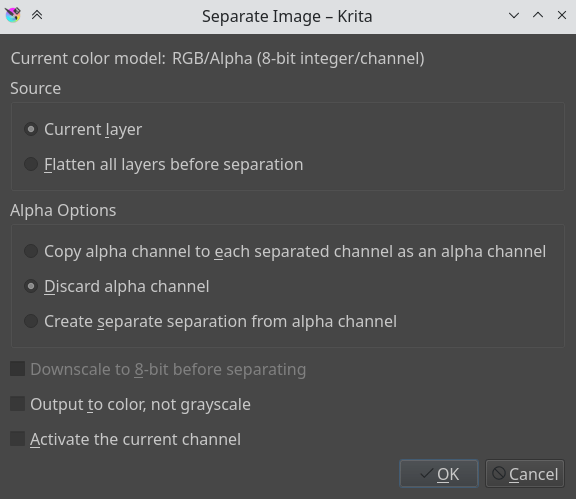
This powerful image manipulation characteristic lets you divide an image into its different components or channels.
This is useful for people working in impress, or people manipulating game textures. There's no combine functionality, but what you can practice, if using colored output, is to ready 2 of the channels to the addition Blending Modes.
For grayscale images in the RGB space, you can employ the Copy Red, Copy Green and Copy Blue blending modes, with using the red one for the cerise channel image, etc.
Saving, Exporting and Opening Files
When Krita creates or opens a file, it has a copy of the file in memory, that it edits. This is part of the manner how computers work: They make a copy of their file in the RAM. Thus, when saving, Krita takes its copy and copies it over the existing file. There's a couple of tricks you can do with saving.
- Save
-
Krita saves the current image in its memory to a defined place on the difficult-bulldoze. If the prototype hadn't been saved before, Krita will ask you where to save it.
- Save As…
-
Make a copy of your electric current file past saving it with a unlike name. Krita will switch to the newly made file as its active document.
- Open up…
-
Open up a saved file. Adequately straightforward.
- Export…
-
Salve a file to a new location without actively opening information technology. Useful for when you are working on a layered file, but simply need to save a flattened version of it to a certain location.
- Open up Existing Document as Untitled Certificate…
-
This is a scrap of an odd 1, but information technology opens a file, and forgets where you saved it to, then that when pressing 'relieve' information technology asks you where to save it. This is as well called 'import' in other programs.
- Create Re-create from Current Prototype
-
Makes a new copy of the current image. Similar to , but then with already opened files.
- Salve Incremental Version
-
Saves the current image as
filename_XXX.kraand switches the current document to it. - Salvage Incremental Backup
-
Copies and renames the last saved version of your file to a fill-in file and saves your document nether the original name.
Annotation
Since Krita's file format is compressed data file, in case of a corrupt or broken file you tin open it with archive managers and excerpt the contents of the layers. This volition help yous to recover as much equally possible data from the file. On Windows, y'all will need to rename information technology to filename.zip to open information technology.
lambertprighorky1989.blogspot.com
Source: https://docs.krita.org/en/user_manual/working_with_images.html
0 Response to "How to Upload Pictures Directly to the Kirita Canvas"
Post a Comment